Summary
The Blessing of Dimensionality in LLM Fine-tuning
- 核心: 提出一个统一的机制假说:LLM fine-tuning 的 reward landscape 只有少量 curvature-active directions;这些 stiff modes 解释早期进步,大量 weak modes 中积累的随机性解释后期退化,同一低维结构也让小 population ES 仍能碰到改进方向。
- 方法: 用 Gaussian-smoothed ES 观察 reward geometry;用 quadratic OU/AR(1) toy model 构造 rise-then-decay 的充分机制;再以 one-step best-of- perturbation 和 perturbation-SLQ 检查 Qwen2.5-Instruct 0.5B 到 7B 的局部 reward landscape。
- 结果: 在 GSM8K、ARC-C、WinoGrande 的固定 train pools 上,best-of- 曲线约在 到 40 后进入 diminishing returns,且没有随模型规模系统右移。这个结果支持“improving tail 在所测尺度上没有消失”,但没有直接测出 curvature dimension,也不等于端到端 ES 已被证明可扩展。
- Sources: paper | website
- Rating: 2 - Frontier(provisional): 问题和统一视角值得跟进,但机制识别、指标定义和复现 artifact 还不足以支撑 Foundation。
Key Takeaways:
- 这篇的 delta 是 curvature,而不是再讲一次 intrinsic dimension: 它把局部 Hessian 谱、optimizer noise 与 ES population 联系起来;不要把 误读成 intrinsic dimension 约为 30。
- toy model 给的是充分机制: heterogeneous relaxation rates、固定噪声和特定 initialization 可以严格产生 rise-then-decay;真实 LLM 的下降是否由这套机制引起,论文没有完成 causal identification。
- 主实验直接支持 tail accessibility 在所测规模内没有明显恶化: 从 0.5B 到 7B,固定 population 仍能在某些局部 下找到正向 perturbation。它没有验证 improving perturbations 确实共享同一个 top-curvature projection。
- ES noise model 与 OU abstraction 没有接上: vanilla ES estimator noise 的显式 prefactor 约为 ,但 OU toy model 直接采用 。因此“减小 就会降低真实 ES update noise”不是本文推导出的结论。
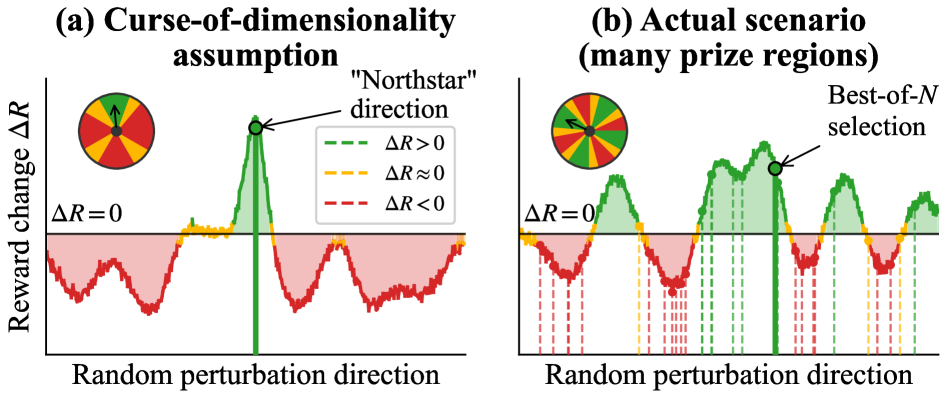
Teaser. 作者把两种几何直觉画成 needle-in-a-haystack 与 many-prize regions;后者要求 projected improving set 保持 non-negligible、且不随规模显著缩小的 Gaussian mass。
论文在问什么
出发点有两个。
- ES 的 scale 反常识:weight-perturbation ES 用有限个随机方向估计更新。经典 zeroth-order worst-case intuition 预期 sample complexity 会随 ambient dimension 迅速恶化,但前作已经观察到 也能 fine-tune billion-parameter LLM。
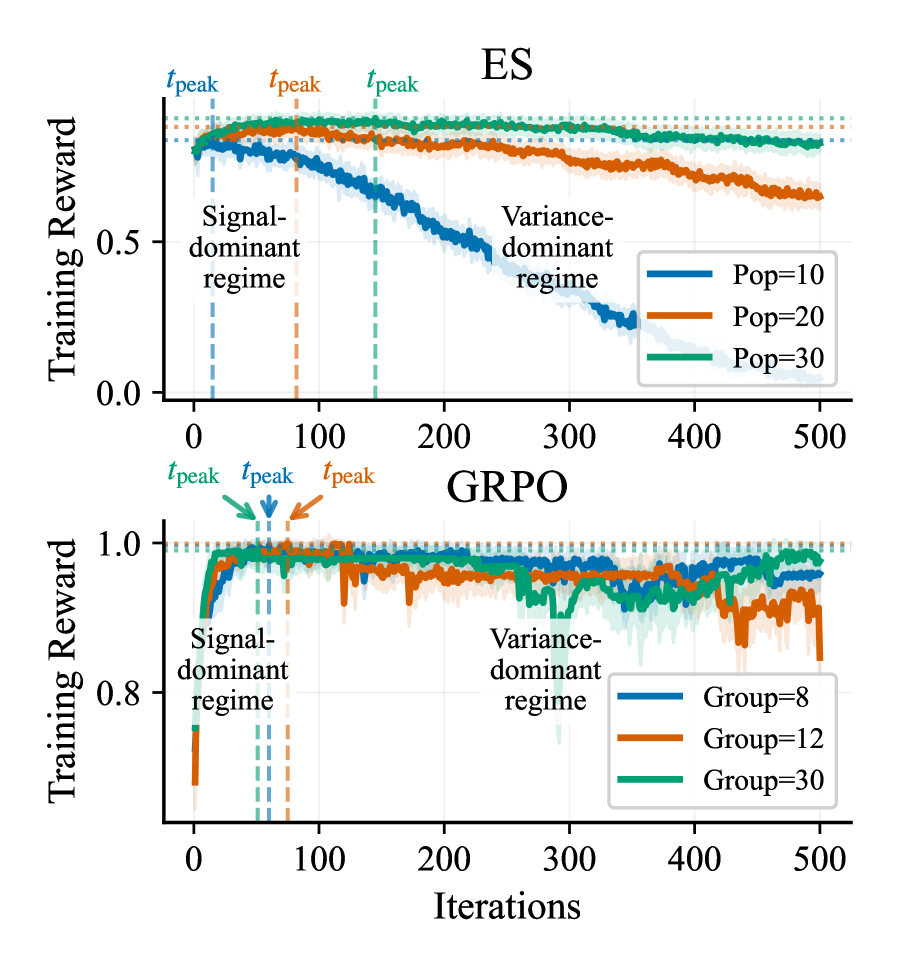
- 固定随机性下的 rise-then-decay:在 Qwen2.5-1.5B-Instruct / GSM8K 上,ES 与 GRPO 的 training reward 都可能先升、到峰值、再回落;population 或 group size 会改变 peak time 与下降幅度。
Figure 1. ES 与 GRPO 的 motivating observation。两种方法都只展示单一 model/task,GRPO 曲线更噪;这是一条现象证据,不是共享机制的识别实验。
论文的 central hypothesis 是:决定局部优化的不是参数总数,而是一个规模增长更慢的 curvature-active subspace。少数 stiff directions 提供主要 improvement signal,weak directions 则提供大量近似冗余自由度,并在 constant noise 下缓慢积累 variance。
这里需要区分三个维度概念和一个经验量:
| 概念 | 问的是什么 | 本文是否直接测量 |
|---|---|---|
| Ambient dimension | 模型有多少参数 | 是,比较 0.5B 到 7B |
| Intrinsic dimension / | 随机 维子空间能否训练到目标性能 | 否,见 Intrinsic Dimension 与 SAID |
| Curvature-active dimension | 局部 reward Hessian 的谱质量集中在多少方向 | 只在 Appendix G.10 给出定义不完整的 proxy |
| Accessibility | 次随机 perturbation 能否碰到 reward distribution 的正向右尾 | 是,best-of- 是主实验 |
所以,本文可靠的新信息是 accessibility across scale;“因为 很小,所以 accessible”仍是对数据的解释。
ES 为什么能充当 reward-geometry probe
对不可微、离散或 sampling-defined 的 task reward ,ES 实际优化 Gaussian-smoothed objective:
用 个 perturbations 做 Monte Carlo:
同时决定 probe 的空间尺度与 estimator statistics。论文利用这一点,把 ES 当成 coarse-grained landscape probe,而不是把 optimizer benchmark 当作本文的主贡献。在真实 landscape 上,toy model 中的 应对应 的局部 Hessian,不一定等于 raw reward 的 Hessian;改变 也会改变被探测的 geometry。
两种 noise scaling 不能混为一谈
Section 3 写出 ;Section 4 的 toy model 随后直接假设 additive update noise 为 ,即 diffusion 。后者是一个 ES-like abstraction,不是从前者推出。固定 只改变 时,两者都有 趋势;一旦讨论 schedule,差异就不能忽略。
Rise-then-decay:toy model 真正证明了什么
在局部 maximizer 附近,论文用 quadratic reward
以及 additive-noise ascent
隔离 curvature 与 noise 的作用。对 eigenvalue ,对应 mode 是 AR(1):
对 且 的 stable modes,其 mean 按 衰减,stationary variance 为
把 expected reward 相对 terminal plateau 的偏差写开:
由此可见,peak 需要的不只是“stiff modes + noise”:
- stiff modes 初始离 optimum/noise equilibrium 较远,;它们快速衰减,使 reward 先升;
- weak modes 初始优于最终 noise floor,;它们慢慢积累 variance,使 reward 后降;
- 两组 mode 必须有不同 relaxation rates,amplitude 还要足以令 peak 落在 。
这在 toy model 中是解析成立的 sufficient mechanism。exactly flat modes 在 additive noise 下是 random walk,没有 stationary variance,因此也被排除在上述公式外。真实 ES/GRPO trajectory 是否满足局部 quadratic、isotropic and state-independent noise、single-basin 与对应 initialization 条件,论文没有验证。
GRPO 还多一层 operator mismatch:update dynamics 由 surrogate-loss Hessian 决定,Figure 1 画的却是 task reward。Appendix C 的解释隐含两者局部对齐,但没有测量这种对齐。
Appendix F 的 Countdown 也比文字结论弱。Figure 10 中 有清楚的 train/test decay, 主要是平台或轻微回落, 的 training reward 到 2000 iterations 仍在上升;这不支持“all population sizes exhibit pronounced rise-then-decay”。该图也没有给 model、split size、、step size、seed、重复次数或 error band。
数学审计:附录里三个容易被略过的问题
- mixed signs 还不够:假设 (例如取 ),two-mode 情况除 外,还需要 才有 。论文把 mixed signs 写成 peak 的充分条件,少了 rate ordering 与这条 inequality。
- 更强的 timescale separation 不必然让 peak 更晚:其闭式解同时改变 numerator 与 denominator,正文的单调性描述不由公式保证。
- Appendix 的 不是 stiff dimension:
当 时,它趋近 ;每个再小但非零的 eigenvalue 都贡献约 1。Figure 3 虽标出 stiff modes,但其 112 个 weak modes 的 ,所以小步长下 ,不是 16。任意 weak mode 都要经过约 的时间才接近 equilibrium;这个 infinite-horizon quantity 在 时还会发散并超过 。它更像 stability-weighted rank,不是 outlier/stiff directions 数量。
主实验:固定 population 能否接触 improving tail
论文令 张成假设中的 curvature-active subspace,,并额外假设 finite- improvement 主要由这个 projection 决定。若 projected improving region 为 ,full-space improving set 被写成
固定 的 preimage 是 维 affine subspace,作者称这种 many-to-one structure 为 degeneracy。这个 cylinder equality 不是 low-rank Hessian 自动带来的:orthogonal gradient、weak-but-nonzero curvature 与 higher-order terms 都可能让同一 对应不同 reward。即使 projection-only assumption 成立,高维 fiber 本身也不保证高 probability mass;accessibility 仍取决于 在 Gaussian measure 下有多大。
Probe protocol
| 维度 | 设置 |
|---|---|
| Models | Qwen2.5-Instruct 0.5B / 1.5B / 3B / 7B |
| Tasks | GSM8K、ARC-C、WinoGrande 的 training split,binary reward |
| Evaluation | 每任务固定 prompts;greedy decoding;generation seed 42 |
| Perturbation | ,,不做 norm normalization |
| Candidate pool | 每个 condition 每 batch 有 candidates;独立 batch 数 未披露 |
| Population | ;从 candidate pool 无放回抽取并估计 expected maximum |
| Numeric | 模型以 bfloat16 加载;perturbation arithmetic dtype 未说明;正文提到 baseline drift checks,但后文没有报告 |
核心 proxy 是
并用 做 headroom normalization。这个归一化会放大 near-saturated model 的离散误差:GSM8K-7B 的 ,一个 prompt 的 raw accuracy step 是 ,归一化后约为 0.052;relative gain 0.2 只对应约四个 prompts。
Figure 6. 主实验的直接结果:固定 时,四种规模的 best-of- 曲线约在 到 40 后进入 diminishing returns;固定 时,每个任务都存在保持正向 right tail 的局部 。
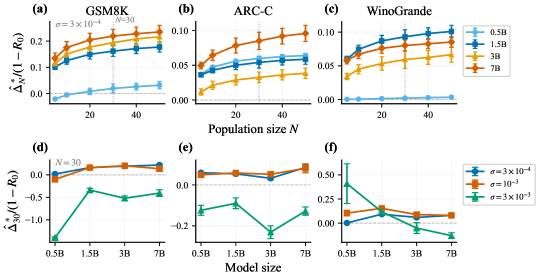
这张图支持的结论很具体:在这四个 checkpoints、三个 train pools 和所测 中,没有观察到 population requirement 随参数量系统恶化。它不能单独建立以下更强结论:
- best-of- 选出一个好 candidate,不等于 reward-weighted ES update 有足够 SNR,也不等于多步训练稳定;
- expected maximum 天然有 diminishing returns; 的 flattening 不是 curvature dimension 的估计;
- 实验没有估计 、,也没有做 top eigenspace 与 orthogonal complement 的 structured-noise ablation,因而没有直接验证 degeneracy;
- winner 在同一个 320-prompt pool 上被选择和汇报,没有独立 holdout 重新评估;固定 pool 避免了在 max 内 bootstrap 的额外 inflation,但没有消除 selection bias;
- 未归一化,。跨规模固定 per-coordinate 并不等于固定 parameter-space radius。
- Appendix 的 只是达到有限 所得 improvement 的 90%,不是 infinite-population asymptote;Figure 16 还出现了 protocol grid 以外的 ,计算或插值方式未交代。
另一个实用边界是 scale sensitivity:较大的 会把整个 outcome distribution 推向负侧;论文确实展示了这类 failure regime。所谓 blessing 不是“任意 random search 都可行”,而是“存在一个足够 local 的尺度窗口”。
Appendix G.10:定义不完整的 curvature proxy
论文还在 GSM8K 的 100 个 train prompts 上,对 使用 perturbation-based HVP + SLQ,报告 、negative spectral mass、participation ratio 与 effective rank。
Figure 17. participation ratio 与 effective rank 随模型规模下降,构成对 central hypothesis 的直接 proxy;但图中数值约为 ,标准定义本应不小于 1,说明这里至少做了未披露的 normalization 或尺度变换。
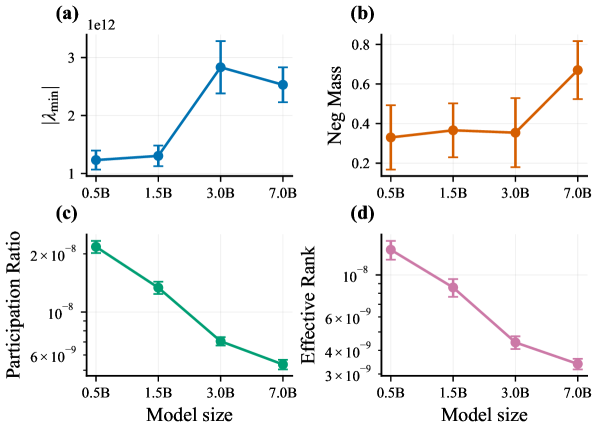
Appendix 没有给 smoothing 、perturbation HVP estimator、Monte Carlo sample 数、Lanczos steps/probes,也没有定义这两个 concentration metrics 及其 normalization。Figure 17 虽报告 5 seeds,caption 的 “seed variability” 也没有说明 error bar 是 SD、SE 还是其他统计量。若 metrics 按参数量 归一化,图只说明 relative spectral concentration 增强;absolute active dimension 仍可能缓慢增长。官网把它概括成“larger models exhibit lower effective curvature dimension”,比当前证据更强。
Practical implications:目前只是待验预测
如果 curvature-variance mechanism 成立,几种干预自然出现:靠近 peak 时 early stop;随训练增大 或降低 effective noise;使用 layerwise、low-rank 或 learned-covariance perturbations 对准 active subspace;把 perturbation exploration 与 gradient update 混合。
论文没有对这些 intervention 做 LLM ablation。尤其是“减小 可降低 ES update noise”受前述 noise-scaling gap 影响,不能直接从 toy model 搬到 Algorithm 1。下一步需要能推翻该机制的实验,而不只是更多 accessibility curves:
- 在训练 trajectory 上同时估计 reward Hessian top subspace、update-noise covariance 与 mode-wise bias/variance;
- 比较 top-subspace、orthogonal-complement 与 isotropic perturbations,检验 right tail 是否真的由前者控制;
- 对 best candidate 使用独立 holdout,并跨 model family、checkpoint 与 reward 类型复现;
- 用 fixed-、weight-relative 和 layer-normalized noise 排除 parameterization confound。
关联工作
基于
- Intrinsic Dimension: 定义随机子空间达到目标性能所需的最小维数。本文借用“高 ambient dimension 不代表高 effective dimension”的问题意识,但没有重测 。
- SAID: 已观察到 LM fine-tuning intrinsic dimension 很低,且可能随 model size 下降。本文新增的是 reward-defined zeroth-order setting、rise-then-decay dynamics 与 local tail-accessibility probe。
- Evolution Strategies at Scale: 本文直接前作,提供 可进行 billion-scale LLM fine-tuning、并可与 RL baselines 比较的经验事实;本文没有重新完成 optimizer benchmark,而是在解释该现象。
对比与边界
- LoRA: low-rank update parameterization 不等于 low intrinsic dimension,也不等于 low curvature dimension。本文只把 LoRA 当作低维 adaptation 的旁证。
- RandOpt: 直接把 improving-tail accessibility 变成 sample-select-ensemble 算法,但没有测 Hessian 或 curvature-active subspace;它支持「tail 可被利用」,不独立支持本文的曲率机制。
- Hessian bulk + outliers / tiny sharp subspace: 近零 bulk、少数 outliers 与 GD 集中在小 sharp subspace 都是已有结果。本文的增量是把这条线接到 LLM task reward、ES population 与 non-monotonic dynamics。
- Constant-step OU analyses: stationary covariance 与 noise floor 已有成熟分析;本文的新组合是 mixed relaxation rates + mixed-sign amplitudes 对 rise-then-decay 的解释。
- 权重空间几何: 本文应放在“局部 curvature / optimization dynamics”分支,而不是 representation-space dimensionality 分支。
论文点评
Strengths
- 问题选得好:它没有把“小 population ES 能 work”只当工程现象,而是追问哪类 geometry 会让 worst-case dimensionality intuition 失效。
- 机制足够简单,可被推翻:quadratic mode decomposition 把 signal exhaustion 与 variance accumulation 写成闭式条件;即便 central hypothesis 最后不成立,这个 sufficient mechanism 仍是有用的 baseline explanation。
- 主实验公开 failure window:论文同时报告 mean、、每个 condition 的 empirical histogram、best-of-、 与 large- failure,没有只展示有利尺度。
Weaknesses
- 解释链缺少 alignment test:主实验测 tail mass,没有证明 improving perturbations 的投影落在 top-curvature subspace,更没有排除一阶 gradient alignment 本身即可产生 dimension-insensitive right tail。
- ES-to-OU bridge 没有推导: 与 的差别使 noise scheduling 建议缺乏直接理论依据。
- curvature proxy 定义不全:Figure 17 的 normalization、HVP 与 SLQ 配置均缺失,absolute curvature dimension 无法解释或复现。
- 外部效度窄:单一 Qwen family、四个尺寸、三个标准任务、train-split binary reward、单步 local probe。它支持 0.5B 到 7B 内“未见恶化”,不支持 asymptotic 或 architecture-general claim。
- 若干数学文字比公式更强:two-mode peak 少写 amplitude inequality; 更接近 rank 而非 stiff dimension;timescale separation 与 peak time 的单调关系也没有成立。
可信评估
Artifact 可获取性
- 代码: 未开源。arXiv、作者主页与 Cognizant 页面均未链接官方 repository。
- 模型权重: 使用公开 Qwen2.5-Instruct checkpoints;没有需要发布的新 checkpoint。
- 训练细节: reward-probe 的 models、tasks、、、 grid、generation seed 与 best-of- resampling 写得较清楚;独立 perturbation batch 数 、2000-subset resampling seed、Figure 1/10 的完整训练超参、Figure 17 的 HVP/SLQ 配置未披露。
- 数据集: GSM8K、ARC-C、WinoGrande 均公开;论文称保存了 candidate bitstrings,但没有发布 numerical data。
Claim 可验证性
- ✅ 固定 train-prompt pool 上,所测 perturbation distribution 的 empirical upper tail 在 0.5B 到 7B 内没有系统消失:Figure 6 直接支持,且附录用 empirical histograms、 与 补充;这不是 held-out improvement claim。
- ✅ quadratic additive-noise model 可以产生 rise-then-decay:Appendix A 的 AR(1) 分解给出充分机制,但需补上 positive peak-time 的 amplitude 条件。
- ⚠️ 真实 ES/GRPO 的 decay 来自同一 curvature-variance mechanism:未测 trajectory 上的 eigenspace、noise covariance 或 mode-wise dynamics,其他 nonstationarity 与 basin hopping 也可产生下降。
- ⚠️ best-of- accessibility 来自 low-dimensional curvature / degeneracy:没有直接测 、 或 improving perturbations 的 projection equivalence。
- ⚠️ curvature-active dimension 随规模变得更小:Figure 17 只给单任务 qualitative proxy,且 normalization 未定义;最多支持 relative concentration 可能增强。
- ❌ high dimensionality 本身让优化更容易:当前数据只排除了所测范围内的明显恶化,没有建立维度增加的正因果效应。
Notes
- 沿着 Update-Anchored Post-Training 的一个直接问题是:能否从早期 update trajectory 估计 curvature-active subspace,再用它构造后期低噪声、structured perturbation?这会把本文的解释变成算法,也给出清楚的 falsification route。
- 与 Sparsity Curse 有一处表面张力:本文说少数 stiff modes 主导 improvement,Sparsity Curse 则强调 RLVR update 大量落在 off-principal directions。两篇的 objective、curvature 与观察尺度并不相同,不能直接当作矛盾;可区分两种解释的实验是同时测 task-reward Hessian、surrogate-loss Hessian 与实际 update decomposition。
- Cognizant 官网称 probe 包含 Llama 与 Qwen,但论文的 scaling experiment 只列 Qwen2.5-Instruct。笔记以论文正文为准。
Rating
Metrics (as of 2026-07-10): citation=5, influential=0 (0.0%), velocity=0.94/mo; HF upvotes=1; github N/A(未找到官方仓库)
分数:2 - Frontier(provisional) 理由:它提出了一个 simple、可证伪、直接关联 LLM post-training dynamics 的统一 lens,并用跨规模 reward probes 给出初步支持,因此暂列 Frontier 而非 Archived。它还不是 Foundation:核心构件大量继承 intrinsic-dimension、Hessian 与 OU 工作,curvature-to-accessibility 的机制链尚未被直接验证,Figure 17 又缺定义与 artifact。若后续没有跨 model family 的复现和 eigenspace ablation,应降为 1;若该 framework 被社区实质继承并发展成可靠 probe/optimizer,再考虑升为 3。